Snippets

Filter:

How can I DKIM sign an e-mail? Authentication

To DKIM sign an email you can use the following code in your filter:

use Mail::MIMEDefang::DKIM;  
my ($header, $value) = md_dkim_sign('domain-dkim.key.pem', 'rsa-sha256', 'relaxed/simple', $sender_domain, 'dkim');  
action_insert_header($header, $value);

How can I verify a DKIM signature ? Authentication

To verify a DKIM signature you can use the following code in your filter:

use Mail::MIMEDefang::DKIM;  
my ($result, $domain, $keysize, $btag) = md_dkim_verify();  
if($result eq "pass") {  
  ...  
}

How can I convert winmail.dat TNEF attachments to their original content? Attachments

To convert all attached winmail.dat TNEF attachments to their original content you can use the following code in your filter:

sub filter {
  my($entity, $fname, $ext, $type) = @_;

  if (lc($type) eq "application/ms-tnef" or lc($fname) eq "winmail.dat" ) {
    use Convert::TNEF;
    use File::Type;
    use File::Temp qw(tempfile tempdir);

    my $tnefdir = tempdir(CLEANUP => 1, DIR => "/tmp");
    my $tnef = Convert::TNEF->read_ent($entity,{output_dir=>"$tnefdir"});

    my $ft = File::Type->new();

    for ($tnef->attachments) {
         my $mimetype = $ft->mime_type($_->data);

         my $tnef_entity = action_add_part($entity, "$mimetype", "base64", $_->data, $_->longname, "attachment");
         md_graphdefang_log('tnef_ext', "File: " . $_->longname . " Type: $mimetype");

         filter ($tnef_entity, $_->longname, "", "$mimetype");
    }
    $tnef->purge;
    return action_drop();
  }
  return action_accept();
}

How can I use rspamd to detect spam messages ? Antispam

To use rspamd to detect spam messages you can use the following code in your filter:

 my ($hits, $req, $names, $report, $action, $is_spam) = rspamd_check();
 md_syslog("Warning", "Action: $action, Spam: $is_spam, Names: $names");
 if ($is_spam eq "true") {
   action_change_header("X-Spam-Score", "$hits/$req $names");
   md_syslog("Warning", "Action: $action");
   md_graphdefang_log('spam', $hits, $RelayAddr);
 } else {
   # Delete any existing X-Spam-Score header?
   action_delete_header("X-Spam-Score");
 }

How can I implement greylisting ? Antispam

In order to use use greylisting you should add this code tou your filter:

my $dbh;
sub filter_initialize {
    my($entity) = @_;

    $dbh = DBI->connect($dsn, $username, $auth, {RaiseError => 1});
}

sub filter_recipient {
    my ($recipient, $sender, $ip, $hostname, $first, $helo,
        $rcpt_mailer, $rcpt_host, $rcpt_addr) = @_;

    my $ip_address = $ip;

    # Greylist all the /24 subnet
    #
    # my @ip = split(/\./, $ip);
    # $ip_address = $ip[0] . '.' . $ip[1] . '.' . $ip[2] . '.0';

    my $ret = Mail::MIMEDefang::Actions::action_greylist($dbh, $sender, $recipient, $ip_address);
    if($ret eq "tempfail") {
      return('TEMPFAIL', "Email greylisted, please come back later");
    } elsif($ret eq "reject") {
      return('REJECT', "Go away or deliver email faster");
    } else {
      return ('CONTINUE', "ok");
    }
}

 sub filter_cleanup {
   $dbh->disconnect();
 }

A sample database schema is available in the contrib/greylisting directory.

How can I sign a message with ARC? Authentication

ARC (Authenticated Received Chain) signing should be done in filter_end, after all message processing is complete. It preserves the authentication state of a message as it passes through intermediary mail servers.

use Mail::MIMEDefang::DKIM::ARC;

sub filter_end {
    my($entity) = @_;

    my $domain   = 'example.com';
    my $keyfile  = '/etc/mail/arc-private.key';
    my $selector = 'arc';

    my %arc_headers = md_arc_sign(
        $keyfile,      # path to private key
        'rsa-sha256',  # signing algorithm
        'ar',          # cv= value: 'ar' copies from Authentication-Results
        $domain,
        $domain,       # authserv-id (srvid), usually same as domain
        $selector,
    );

    if (exists $arc_headers{error}) {
        md_syslog('Warning', "ARC signing failed: $arc_headers{error}");
        return;
    }

    # Insert all ARC headers returned by md_arc_sign
    foreach my $hdr (sort keys %arc_headers) {
        action_insert_header($hdr, $arc_headers{$hdr});
    }
}

How can I check SPF records for incoming mail? Authentication

SPF verification should be done in filter_begin, before the message body is processed. The check uses the sender address, relay IP, and optional HELO name.

use Mail::MIMEDefang::SPF;

sub filter_begin {
    my($entity) = @_;

    my ($spf_result, $spf_explanation,
        $helo_result, $helo_explanation) =
            md_spf_verify($sender, $RelayAddr, $Helo);

    md_syslog('Info', "SPF result for $sender: $spf_result ($spf_explanation)");

    if ($spf_result eq 'fail') {
        # Hard SPF fail - reject the message
        return action_bounce("SPF check failed: $spf_explanation");
    }

    if ($spf_result eq 'softfail') {
        # Soft fail - tag but do not reject
        action_change_header('X-SPF-Result', "softfail ($spf_explanation)");
    }

    if ($spf_result eq 'pass') {
        action_change_header('X-SPF-Result', 'pass');
    }
}

How can I append a disclaimer to outgoing messages? Attachments

Disclaimers are best appended in filter_end, after all message parts have been processed. append_text_boilerplate handles plain-text parts and append_html_boilerplate handles HTML parts, inserting the HTML disclaimer before the closing </body> tag when possible.

use Mail::MIMEDefang::MIME;

sub filter_end {
    my($entity) = @_;

    # Only append disclaimer to outbound mail
    return unless $RelayAddr =~ /^(192\.168\.|10\.|172\.1[6-9]\.|172\.2\d\.|172\.3[01]\.)/;

    my $text_disclaimer = "\n--\nThis message and any attachments are confidential.\n";
    my $html_disclaimer = '<br><hr><p style="font-size:small;color:#666">'
        . 'This message and any attachments are confidential.</p>';

    append_text_boilerplate($entity, $text_disclaimer, 0);
    append_html_boilerplate($entity, $html_disclaimer, 0);
}

How can I verify BIMI records for incoming mail? Authentication

BIMI (Brand Indicators for Message Identification) should be checked in filter_begin. A BIMI record is only valid when the sending domain passes DMARC at enforcement level (p=quarantine or p=reject). Install the optional Mail::BIMI Perl module for full SVG logo and VMC certificate validation.

use Mail::MIMEDefang::BIMI;

sub filter_begin {
    my($entity) = @_;

    # Extract the From: domain
    my $from_domain = $sender;
    $from_domain =~ s/^.*\@//;

    # Check for a BIMI-Selector header and get the selector value
    my $selector = md_bimi_get_selector($entity);

    # These values should come from a prior DMARC check, e.g. via md_authres
    my $dmarc_result = 'pass';   # 'pass' or 'fail'
    my $dmarc_policy = 'reject'; # 'none', 'quarantine', or 'reject'

    my $bimi_result = md_bimi_verify(
        $from_domain,
        $dmarc_result,
        $dmarc_policy,
        $selector,
    );

    md_syslog('Info', "BIMI result for $from_domain (selector=$selector): $bimi_result");

    if ($bimi_result eq 'pass') {
        my $record = md_bimi_lookup($from_domain, $selector);
        if ($record) {
            action_add_header('BIMI-Indicator', $record->{l});
        }
    }
}

How can I add an Authentication-Results header? Authentication

The Authentication-Results header consolidates SPF, DKIM, DMARC, and BIMI results into a single header, making them available to downstream mail clients and filters. Add it in filter_begin so it is present before the message body is processed.

When the optional Mail::BIMI module is installed and $bimi_domain is supplied, md_authres will append a bimi=pass (or bimi=fail) result automatically.

use Mail::MIMEDefang::Authres;

sub filter_begin {
    my($entity) = @_;

    # Extract the From: domain for BIMI lookup (optional)
    my $from_domain = $sender;
    $from_domain =~ s/^.*\@//;

    my $authres = md_authres(
        $sender,       # envelope sender (MAIL FROM)
        $RelayAddr,    # connecting IP address
        $MyHostName,   # this server's hostname
        $Helo,         # EHLO/HELO name (optional)
        $from_domain,  # From: domain for BIMI (optional)
    );

    action_insert_header('Authentication-Results', $authres);
}

How can I use SpamAssassin to detect spam? Antispam

SpamAssassin scanning should be done in filter_end, after the full message is assembled. spam_assassin_check returns hits, required threshold, triggered rule names, and a report. Use md_spamc_init / md_spamc_check instead when using SpamAssassin 4.0.1+ in client mode.

use Mail::MIMEDefang::Antispam;

sub filter_end {
    my($entity) = @_;

    my ($hits, $required, $names, $report) = spam_assassin_check();

    md_syslog('Info', "SpamAssassin: score=$hits required=$required rules=$names");

    if ($hits >= $required) {
        # Tag the message as spam and add score header
        action_change_header('X-Spam-Flag',   'YES');
        action_change_header('X-Spam-Score',  "$hits / $required");
        action_change_header('X-Spam-Report', $names);
        md_graphdefang_log('spam', $hits, $RelayAddr);

        if ($hits >= 10) {
            # Reject very high-scoring messages outright
            return action_bounce("Message rejected as spam (score $hits)");
        }
    } else {
        action_change_header('X-Spam-Flag',  'NO');
        action_change_header('X-Spam-Score', "$hits / $required");
    }
}

How can I scan messages for viruses? Antivirus

Virus scanning should be done in filter_end to inspect the fully assembled message. message_contains_virus calls every installed virus scanner (e.g. ClamAV) and returns the scanner name, the virus name, and a code ('ok', 'virus', or 'error').

use Mail::MIMEDefang::Antivirus;

sub filter_end {
    my($entity) = @_;

    my ($code, $category, $action) = message_contains_virus();

    if ($code eq 'virus') {
        md_syslog('Warning',
            "Virus detected in message from $sender ($RelayAddr): $category");
        md_graphdefang_log('virus', $category, $RelayAddr);
        return action_bounce("Message rejected: virus detected ($category)");
    }

    if ($code eq 'error') {
        md_syslog('Warning',
            "Virus scanner error for message from $sender: $category");
        # Tempfail on scanner error to avoid letting infected mail through
        return action_tempfail("Temporary error during virus scan, please try again");
    }
}

Since MIMEDefang 3.8 each scanner lives in its own module, compiled only when it is used: Mail::MIMEDefang::Antivirus::ClamAV, Mail::MIMEDefang::Antivirus::NAI and, for scanners no longer maintained, Mail::MIMEDefang::Antivirus::Legacy::*. The function names are unchanged, so filters keep working as they are.

How can I check if a relay is blacklisted (RBL)? Antispam

RBL (Real-time Blackhole List) checks should be done in filter_begin or filter_sender to reject blocked senders as early as possible. Use relay_is_blacklisted for a single RBL or relay_is_blacklisted_multi_count to query several RBLs simultaneously and reject based on a hit count threshold.

use Mail::MIMEDefang::Net;

sub filter_begin {
    my($entity) = @_;

    # Single RBL check
    my $result = relay_is_blacklisted($RelayAddr, 'zen.spamhaus.org');
    if ($result) {
        md_syslog('Warning', "Relay $RelayAddr listed in zen.spamhaus.org ($result)");
        return action_bounce("Mail rejected: $RelayAddr is blacklisted");
    }

    # Multi-RBL check: reject if listed in 2 or more RBLs
    my @rbls = qw(zen.spamhaus.org bl.spamcop.net dnsbl.sorbs.net);
    my $hit_count = relay_is_blacklisted_multi_count($RelayAddr, @rbls);
    if ($hit_count >= 2) {
        md_syslog('Warning',
            "Relay $RelayAddr listed in $hit_count RBLs - rejecting");
        return action_bounce(
            "Mail rejected: sender IP listed in multiple blacklists");
    }
}

How can I block dangerous file attachments? Attachments

Attachment filtering is done in filter, which is called once per MIME part. The example below drops executables, scripts, and macro-enabled Office documents. Use action_drop_with_warning to notify the recipient, or action_defang to rename the attachment and neutralise it rather than removing it entirely.

sub filter {
    my($entity, $fname, $ext, $type) = @_;

    # Extensions considered dangerous
    my @blocked_extensions = qw(
        exe com bat cmd scr pif vbs vbe js jse
        ps1 ps2 jar docm xlsm pptm
    );

    my $lext = lc($ext);
    $lext =~ s/^\.//;  # strip leading dot if present

    if (grep { $_ eq $lext } @blocked_extensions) {
        md_syslog('Warning',
            "Blocked attachment '$fname' (.$lext) from $sender");
        md_graphdefang_log('attachment_blocked', $fname, $RelayAddr);
        return action_drop_with_warning(
            "An attachment named '$fname' was removed because its file type "
            . "(.$lext) is not permitted.");
    }

    return action_accept();
}

How can I retrieve and act on DMARC records? Authentication

DMARC record lookups are best done in filter_begin so the policy is available for downstream checks (e.g. BIMI verification or per-policy actions). md_get_dmarc_record returns a string with the raw DMARC TXT record, or undef if no record exists.

use Mail::MIMEDefang::Net;

sub filter_begin {
    my($entity) = @_;

    my $from_domain = $sender;
    $from_domain =~ s/^.*\@//;

    my $dmarc_record = md_get_dmarc_record($from_domain);

    unless (defined $dmarc_record) {
        md_syslog('Info', "No DMARC record found for $from_domain");
        return;
    }

    md_syslog('Info', "DMARC record for $from_domain: $dmarc_record");

    # Parse the policy tag from the record
    my ($policy) = ($dmarc_record =~ /\bp=(\w+)/i);
    $policy //= 'none';

    md_syslog('Info', "DMARC policy for $from_domain: $policy");

    if ($policy eq 'reject') {
        # Domain publishes p=reject - be stricter on authentication failures
        action_change_header('X-DMARC-Policy', "reject ($from_domain)");
    } elsif ($policy eq 'quarantine') {
        action_change_header('X-DMARC-Policy', "quarantine ($from_domain)");
    } else {
        action_change_header('X-DMARC-Policy', "none ($from_domain)");
    }
}

How do I initialise the async engine? Async

Call md_async_init once at package scope (outside any sub), after the use statements at the top of your filter file. It sets up the AnyEvent event loop that all async checks share. Requires the optional CPAN modules AnyEvent, AnyEvent::DNS, AnyEvent::Socket, and AnyEvent::Util.

use Mail::MIMEDefang::Async;
use Mail::MIMEDefang::Async::Checks qw(
    md_async_check_dnsbl
    md_async_check_rdns
    md_async_check_spf_record
    md_async_check_dmarc_record
    md_async_check_mx_exists
);
use Mail::MIMEDefang::Async::Results qw(
    md_async_interpret_dnsbl
    md_async_interpret_rdns
    md_async_interpret_spf_txt
    md_async_interpret_dmarc
    md_async_score_results
);

md_async_init(
    max_concurrency => 8,   # max parallel checks in flight
    global_timeout  => 10,  # hard wall-clock limit for the whole batch (seconds)
    dns_timeout     => 5,   # per-DNS-query timeout (seconds)
    socket_timeout  => 5,   # per-socket-connection timeout (seconds)
);

These settings apply to every call to md_async_run_checks() in the filter. Tune global_timeout to stay within your MTA's milter socket timeout.

How do I use async drop-in replacements for common checks? Async

Mail::MIMEDefang::Async provides async drop-in replacements for the most common blocking network calls. After calling md_async_init at package scope, you can swap these in place of their synchronous counterparts in filter_begin or filter_sender with no other changes to your filter logic.

use Mail::MIMEDefang::Async;

sub filter_begin {
    my($entity) = @_;

    # Drop-in for relay_is_blacklisted() from Mail::MIMEDefang::Net
    my $listed = md_async_relay_is_blacklisted($RelayAddr, 'zen.spamhaus.org');
    if ($listed) {
        md_syslog('Warning', "Relay $RelayAddr listed in zen.spamhaus.org");
        return action_bounce("Mail rejected: $RelayAddr is blacklisted");
    }

    # Drop-in for md_spf_verify() from Mail::MIMEDefang::SPF
    my ($spf_result, $spf_exp) = md_async_spf_verify($sender, $RelayAddr, $Helo);
    if ($spf_result eq 'fail') {
        return action_bounce("SPF check failed: $spf_exp");
    }

    # Drop-in for md_get_dmarc_record() from Mail::MIMEDefang::Net
    my $from_domain = $sender;
    $from_domain =~ s/^.*\@//;
    my $dmarc_raw = md_async_dmarc_verify($from_domain);
    if (defined $dmarc_raw) {
        my ($policy) = ($dmarc_raw =~ /\bp=(\w+)/i);
        md_syslog('Info', "DMARC policy for $from_domain: " . ($policy // 'none'));
    }
}

sub filter_end {
    my($entity) = @_;

    # Drop-in for md_spamc_check() from Mail::MIMEDefang::Antispam (needs spamd)
    my ($score, $threshold, $report, $isspam) = md_async_spamc_check(
        host => '127.0.0.1',
        port => 783,
    );
    if (defined $score && $isspam) {
        action_change_header('X-Spam-Flag',  'YES');
        action_change_header('X-Spam-Score', "$score / $threshold");
    }

    # Drop-in for rspamd_check() from Mail::MIMEDefang::Antispam
    my ($hits, $req, $tests, $rpt, $action, $is_spam) = md_async_rspamd_check();
    md_syslog('Info', "Rspamd: action=$action spam=$is_spam score=$hits/$req");
}

How do I run multiple DNS checks in parallel with scoring? Async

md_async_run_checks fires all checks concurrently and blocks until every one completes or the global_timeout fires. Use md_async_score_results to tally the interpreted results into a weighted spam score and get a single PASS / REJECT / TEMPFAIL decision. This belongs in filter_begin.

use Mail::MIMEDefang::Async;
use Mail::MIMEDefang::Async::Checks qw(
    md_async_check_dnsbl
    md_async_check_rdns
    md_async_check_spf_record
    md_async_check_dmarc_record
    md_async_check_mx_exists
);
use Mail::MIMEDefang::Async::Results qw(
    md_async_interpret_dnsbl
    md_async_interpret_rdns
    md_async_interpret_spf_txt
    md_async_interpret_dmarc
    md_async_score_results
);

sub filter_begin {
    my($entity) = @_;

    my $from_domain = $sender;
    $from_domain =~ s/^.*\@//;

    # All checks fire at once; wall-clock cost = slowest single check
    my $result = md_async_run_checks([
        md_async_check_dnsbl(name => 'zen',
            ip => $RelayAddr, zone => 'zen.spamhaus.org'),
        md_async_check_dnsbl(name => 'spamcop',
            ip => $RelayAddr, zone => 'bl.spamcop.net'),
        md_async_check_rdns(ip => $RelayAddr),
        md_async_check_spf_record(domain => $from_domain),
        md_async_check_dmarc_record(domain => $from_domain),
        md_async_check_mx_exists(domain => $from_domain),
    ]);

    my %interp = (
        zen     => md_async_interpret_dnsbl(
            records => $result->{results}{zen},
            zone    => 'zen.spamhaus.org',
            error   => $result->{errors}{zen}),
        spamcop => md_async_interpret_dnsbl(
            records => $result->{results}{spamcop},
            zone    => 'bl.spamcop.net',
            error   => $result->{errors}{spamcop}),
        rdns    => md_async_interpret_rdns(
            records => $result->{results}{rdns},
            error   => $result->{errors}{rdns},
            ip      => $RelayAddr),
        spf     => md_async_interpret_spf_txt(
            records => $result->{results}{spf},
            error   => $result->{errors}{spf},
            domain  => $from_domain),
        dmarc   => md_async_interpret_dmarc(
            $result->{results}{dmarc}),
    );

    my $score = md_async_score_results(
        interpreted => \%interp,
        reject_at   => 5.0,
        tempfail_at => 12.0,
    );

    md_syslog('Info',
        "Async batch score=$score->{score} action=$score->{action} "
        . "reasons=" . join(', ', @{$score->{reasons}}));

    if ($score->{action} eq 'REJECT') {
        return action_bounce("550 5.7.1 $score->{reasons}[0]");
    }
    if ($score->{action} eq 'TEMPFAIL') {
        return action_tempfail("451 4.7.1 Temporary check failure");
    }
}

Since MIMEDefang 3.8 the same batch can also include the virus and spam scanners (md_async_check_clamd, md_async_check_clamdscan, md_async_check_spamc, md_async_check_rspamd): see How do I run virus and spam scans in parallel?

How do I scan for viruses using the async ClamAV interface? Async

Two async ClamAV variants are available, both used in filter_end:

  • md_async_message_contains_virus_clamd - sends a SCAN command directly to the clamd socket. Fastest, but clamd must run on the same host as MIMEDefang and be able to open the spool path itself.
  • md_async_message_contains_virus_clamdscan - spawns clamdscan --stream, streaming file data over the INSTREAM protocol. Works with both local Unix-socket clamd and remote TCP clamd.

Both return the standard triplet ($code, $category, $action).

Since MIMEDefang 3.8 the virus and spam scanners can also join an md_async_run_checks batch (md_async_check_clamd, md_async_check_clamdscan, md_async_check_spamc, md_async_check_rspamd), so they run in parallel: see How do I run virus and spam scans in parallel? The calls below keep working.

use Mail::MIMEDefang::Async;

sub filter_end {
    my($entity) = @_;

    # Option A: direct clamd socket (local clamd only)
    my ($code, $category, $action) =
        md_async_message_contains_virus_clamd('/var/run/clamav/clamd.sock');

    # Option B: clamdscan --stream (local or remote clamd)
    # my ($code, $category, $action) =
    #     md_async_message_contains_virus_clamdscan('/etc/clamav/clamd.conf');

    if ($code == 1 && $category eq 'virus') {
        md_syslog('Warning',
            "Virus detected in message from $sender ($RelayAddr): $category");
        md_graphdefang_log('virus', $category, $RelayAddr);
        return action_bounce("Message rejected: virus detected ($category)");
    }

    if ($code == 999) {
        md_syslog('Warning',
            "ClamAV error for message from $sender: $category");
        return action_tempfail("Temporary error during virus scan, please retry");
    }
}

How do I check for spam using the async SpamAssassin and Rspamd interfaces? Async

Two async spam-checking variants are available, both used in filter_end:

  • md_async_spamc_check - sends the message to spamd using the raw SPAMC wire protocol over an async socket. Does not require Mail::SpamAssassin::Client.
  • md_async_rspamd_check - POSTs the message to the Rspamd HTTP API over an async TCP socket. Does not require LWP::UserAgent.
  • md_async_spam_assassin_check - runs SpamAssassin in-process (no spamd), reading ./INPUTMSG. Use when spamd is not available.

Each returns the same values as its synchronous counterpart.

Since MIMEDefang 3.8 the virus and spam scanners can also join an md_async_run_checks batch (md_async_check_clamd, md_async_check_clamdscan, md_async_check_spamc, md_async_check_rspamd), so they run in parallel: see How do I run virus and spam scans in parallel? The calls below keep working.

use Mail::MIMEDefang::Async;

sub filter_end {
    my($entity) = @_;

    # --- Option A: async spamc (needs a running spamd) ---
    my ($score, $threshold, $report, $isspam) = md_async_spamc_check(
        host    => '127.0.0.1',
        port    => 783,
        user    => 'defang',
        timeout => 30,
    );

    if (defined $score) {
        action_change_header('X-Spam-Flag',  $isspam  ? 'YES' : 'NO');
        action_change_header('X-Spam-Score', "$score / $threshold");
        if ($isspam && $score >= 10) {
            return action_bounce("Message rejected as spam (score $score)");
        }
    }

    # --- Option B: async Rspamd ---
    my ($hits, $req, $tests, $rpt, $action, $is_spam) =
        md_async_rspamd_check('http://127.0.0.1:11333');

    md_syslog('Info',
        "Rspamd: score=$hits/$req action=$action spam=$is_spam tests=$tests");

    if ($action eq 'reject') {
        return action_bounce("Message rejected by Rspamd (score $hits)");
    }
    if ($action eq 'add header' || $is_spam eq 'true') {
        action_change_header('X-Spam-Score', "$hits/$req $tests");
    }

    # --- Option C: in-process SpamAssassin (no spamd required) ---
    # my ($hits, $required, $names, $full_report) =
    #     md_async_spam_assassin_check();
}

How can I allow authenticated users to send only as themselves? Authentication

A client authenticated as user@example.com must use user@example.com as envelope sender, while unauthenticated clients cannot use addresses of local domains, the same behavior as Postfix reject_sender_login_mismatch. The check is done in filter_sender, so mimedefang must be started with the -s flag; mail injected from 127.0.0.1 is skipped, like permit_mynetworks placed before it.

my %local_domains = map { $_ => 1 } qw(example.com example.net);

sub filter_sender {
    my($sender, $ip, $hostname, $helo) = @_;
    read_commands_file();

    my $login = lc($SendmailMacros{auth_authen} // '');
    (my $addr = lc($sender)) =~ s/^<|>$//g;
    return ('CONTINUE', 'ok') if $addr eq '' or $ip eq '127.0.0.1';
    my ($domain) = $addr =~ /\@(.+)$/;

    if ($login ne '' and $login ne $addr) {
        return ('REJECT', "Authenticated as $login, not allowed to send as $addr");
    }
    if ($login eq '' and $domain and $local_domains{$domain}) {
        return ('REJECT', "Authentication required to send as $addr");
    }
    return ('CONTINUE', 'ok');
}

How do I classify mail with a local machine-learning model? ML

Since MIMEDefang 3.8, Mail::MIMEDefang::ML asks a self-hosted model whether a message is spam or phishing. The same code works with every backend: laya, gliclass or openai (any OpenAI-compatible server). Use it as an additional opinion, not as a replacement for SpamAssassin or rspamd: a backend that cannot be reached, or that is not confident enough, returns no verdict, so mail flow is never blocked.

The Laya and GLiClass model servers are available as the official mimedefang/laya and mimedefang/gliclass Docker images.

use Mail::MIMEDefang::ML;

# Once, at the top of mimedefang-filter
$Mail::MIMEDefang::ML::Config{backend} = 'gliclass';     # or 'laya', 'openai'
$Mail::MIMEDefang::ML::Config{gliclass}{server_url} = 'http://127.0.0.1:8688';

sub filter_end {
    my ($entity) = @_;
    return if message_rejected();

    # $SPFResult, $DKIMResult and $DMARCResult set earlier in the filter
    my $verdict = ml_classify(ml_build_state(
        Entity   => $entity,     # headers, subject and body
        MailFrom => $Sender,
        SPF      => $SPFResult,
        DKIM     => $DKIMResult,
        DMARC    => $DMARCResult,
    ));

    if ($verdict->{error}) {
        md_syslog('info', "ml: no verdict ($verdict->{error})");
        return;
    }

    # answer is 1, 0 or undef (no opinion); confidence is 0.0 .. 1.0
    if ($verdict->{is_phishing}{answer}
        && $verdict->{is_phishing}{confidence} >= 0.90) {
        md_graphdefang_log('ml_phishing', $verdict->{is_phishing}{confidence});
        action_quarantine_entire_message('Suspected phishing');
    } elsif ($verdict->{is_spam}{answer}
             && $verdict->{is_spam}{confidence} >= 0.80) {
        md_graphdefang_log('ml_spam', $verdict->{is_spam}{confidence});
        action_change_header('X-MIMEDefang-ML-Spam', 'yes');
    }
    action_change_header('X-MIMEDefang-ML-Backend', $verdict->{backend});
}

To use the model only against phishing, ask just that question:

$Mail::MIMEDefang::ML::Config{questions} = ['is_phishing'];

The stock models are not trained on your mail: see "TRAINING A MODEL" in the man page and contrib/ml-benchmark in the MIMEDefang sources to measure them against your own corpus. The ml_* events logged above show up in the Spam & ML view of mimedefang-dashboard.

How do I use Ollama or llama.cpp as the ML backend? ML

The openai backend of Mail::MIMEDefang::ML talks to any self-hosted server that implements the OpenAI chat completions API: Ollama, llama.cpp, vLLM or LM Studio. Nothing is sent to third parties: point it at a server you run. Use a model with at least 7-8 billion parameters, and remember that generative models take seconds per message on CPU.

use Mail::MIMEDefang::ML;

$Mail::MIMEDefang::ML::Config{backend}            = 'openai';
$Mail::MIMEDefang::ML::Config{openai}{base_url}   = 'http://127.0.0.1:11434/v1';  # Ollama
$Mail::MIMEDefang::ML::Config{openai}{model}      = 'qwen3:8b';
# Generative models are slow on CPU: allow more time, but keep it
# below the multiplexor busy timeout
$Mail::MIMEDefang::ML::Config{timeout}            = 60;
$Mail::MIMEDefang::ML::Config{openai}{body_head_chars} = 3000;
$Mail::MIMEDefang::ML::Config{openai}{body_tail_chars} = 500;

The rest of the filter is the same as with the other backends, see How do I classify mail with a local machine-learning model?.

If you prefer the faster encoder models (Laya, GLiClass), which classify a message in a single forward pass, run their servers from the official mimedefang/laya and mimedefang/gliclass Docker images and set backend to laya or gliclass.

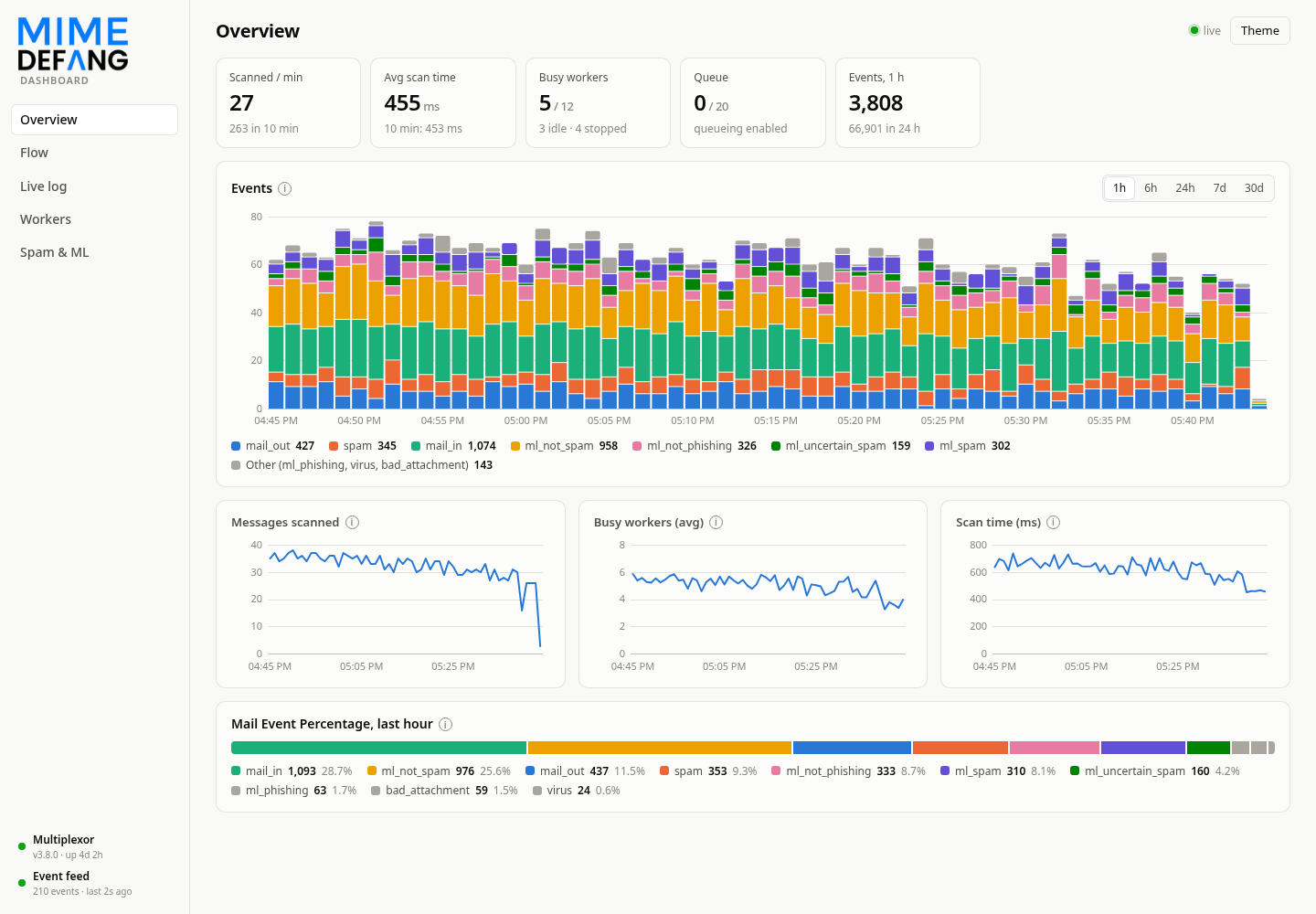
How do I watch the mail flow live with mimedefang-dashboard? Monitoring

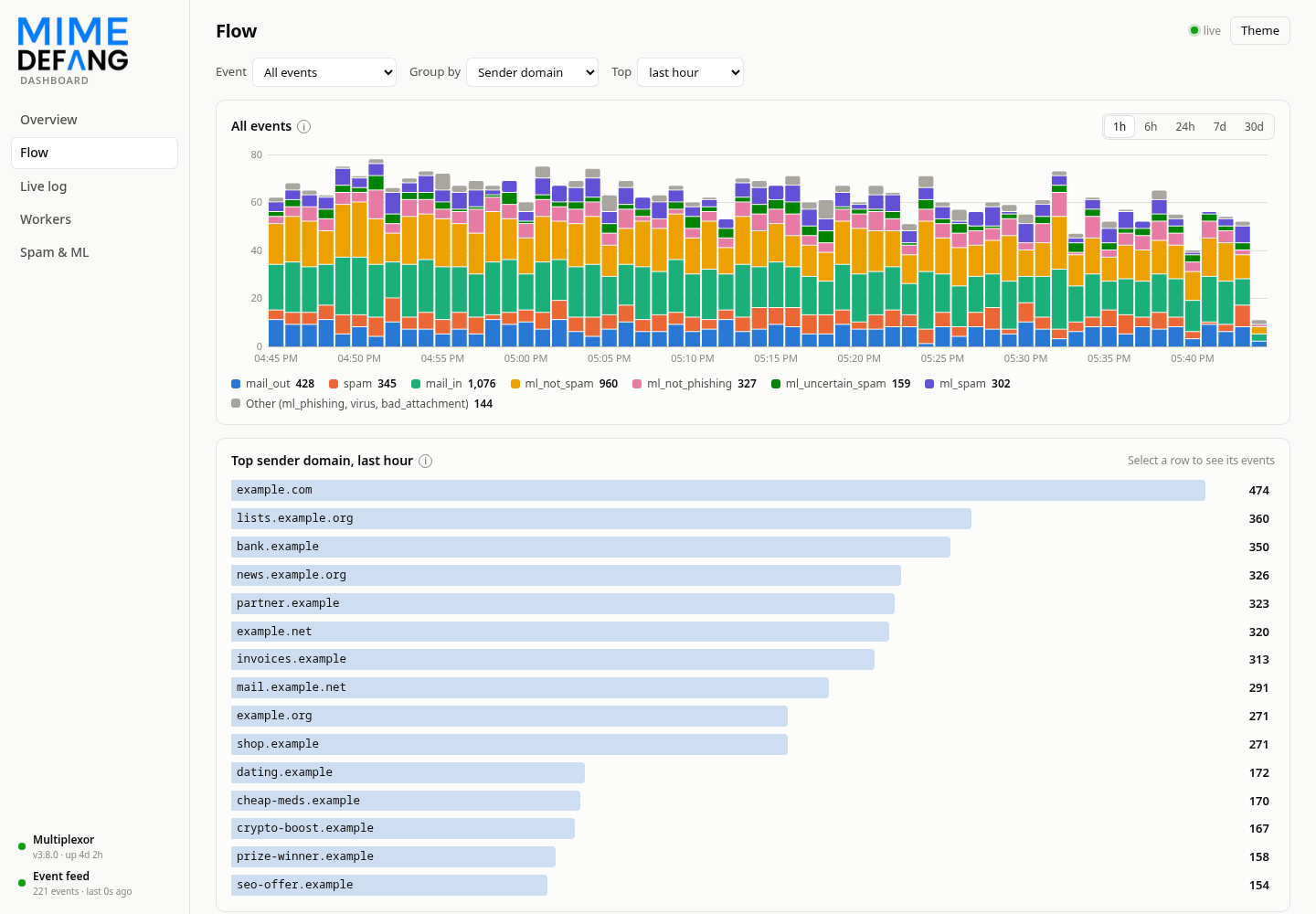
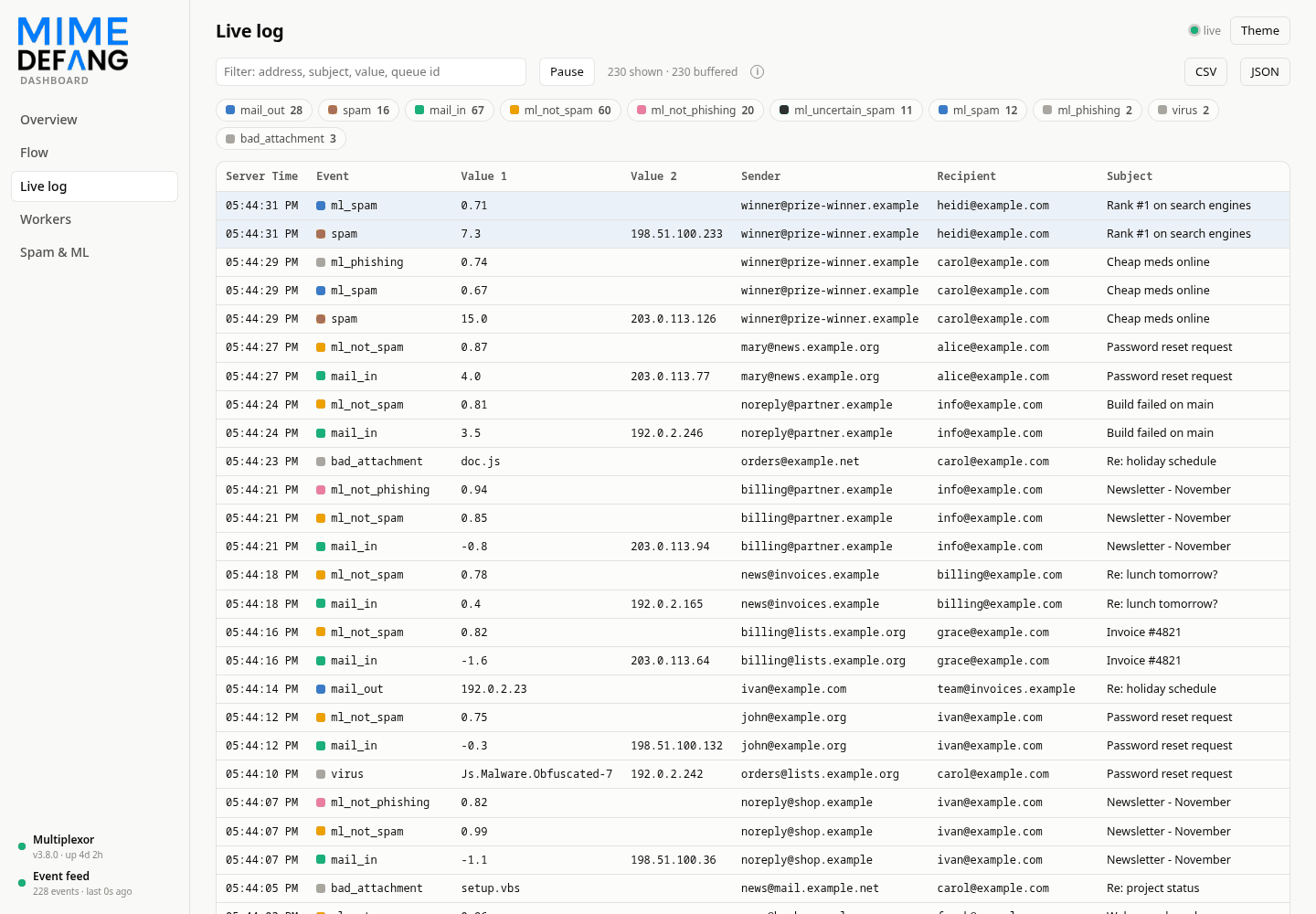
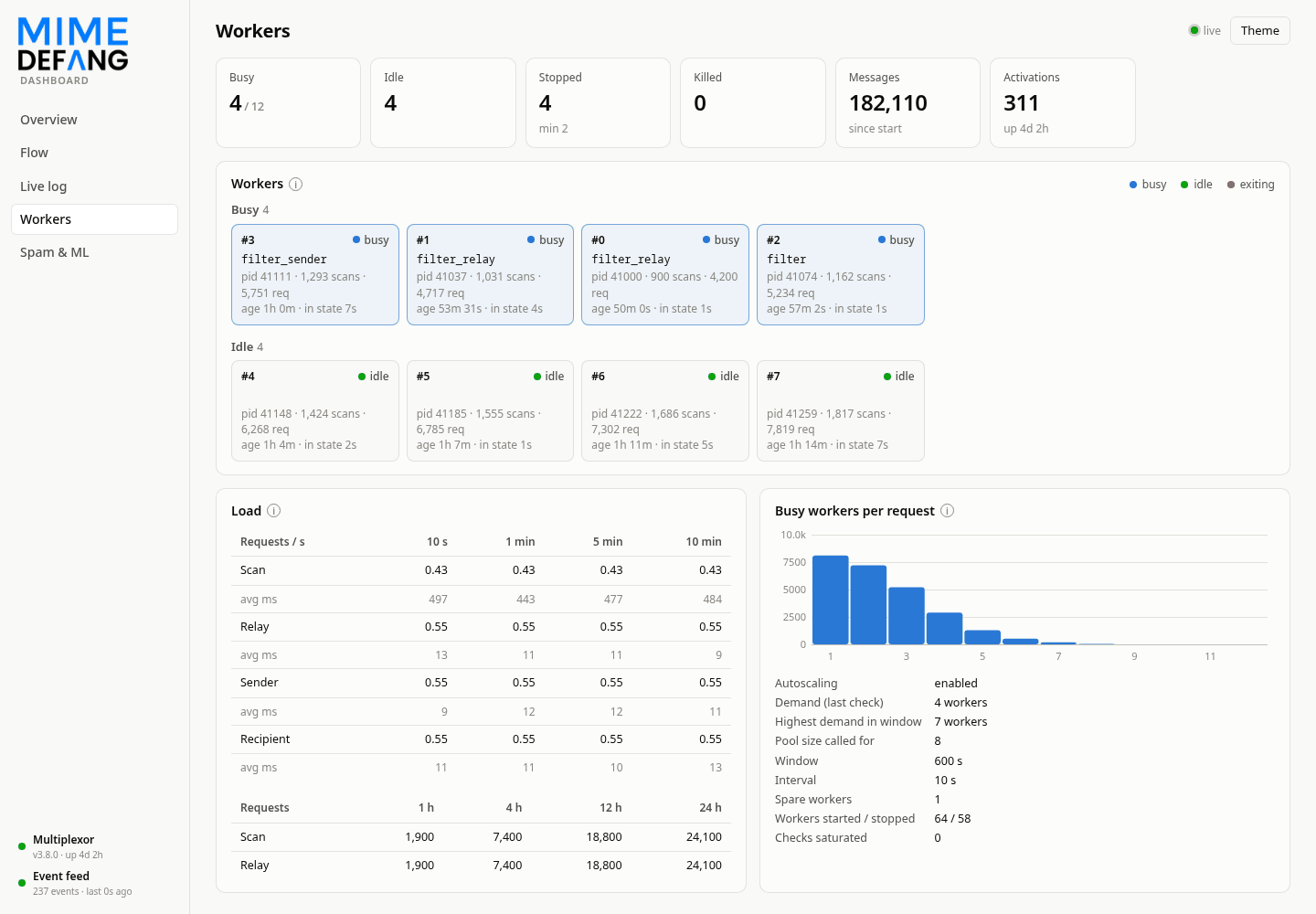
mimedefang-dashboard (MIMEDefang 3.8+) is a live web console for your mail flow: throughput by event, top senders, recipients and domains, a live event log, the multiplexor workers, spam and ML score distributions, and Prometheus metrics at /metrics. It runs its own HTTP server, keeps its data in memory, never reads the mail log and refuses to run as root.

It shows the events your filter logs with md_graphdefang_log; send them to it with md_graphdefang_feed_enable():

# At the top of mimedefang-filter
md_graphdefang_feed_enable();           # socket in the spool directory
# md_graphdefang_log_enable('mail', 1); # optional: keep logging to syslog too

sub filter_end {
    my ($entity) = @_;

    my ($hits, $req, $names, $report) = spam_assassin_check();
    if ($hits >= $req) {
        # $per_message = 2: one line with all the recipients separated by ";"
        md_graphdefang_log('spam', $hits, $RelayAddr, undef, 2);
    } else {
        md_graphdefang_log('mail_in', $hits, $RelayAddr, undef, 2);
    }
}

Delivery never blocks: when the dashboard is not running the events are dropped, so it can be started and stopped at any time. Start it with the systemd unit shipped in systemd-units/, or by hand:

mimedefang-dashboard --listen 127.0.0.1:8689 \
    --state /var/spool/MIMEDefang/dashboard.state

--state keeps the aggregated data across restarts, --anonymize drops the subjects and masks the local parts of addresses. It listens on localhost by default: put it behind a reverse proxy with authentication to reach it from elsewhere.

The overview (sample data):
mimedefang-dashboard overview

Top senders, recipients and domains for each event:
mimedefang-dashboard flow

The live event log; click a row to see all the events of a message:
mimedefang-dashboard live log

Multiplexor workers, load and autoscaler:
mimedefang-dashboard workers

Spam score and ML confidence distributions:
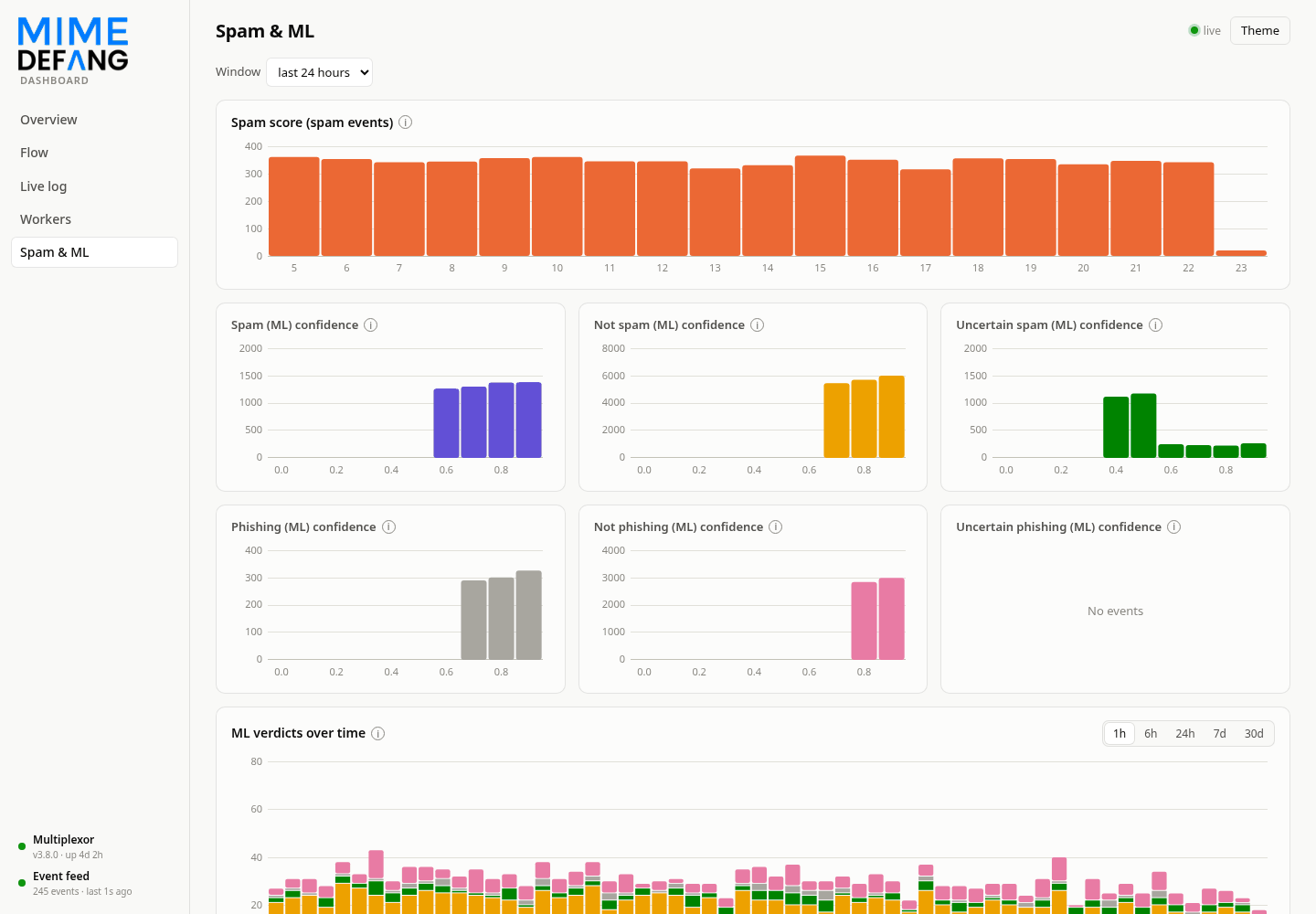
mimedefang-dashboard spam and ML

How do I run virus and spam scans in parallel? Async

Since MIMEDefang 3.8, the virus and spam scanners can be part of an md_async_run_checks batch, so they run at the same time: the message waits for the slowest scanner instead of for the sum of all of them. The check builders are md_async_check_clamd (local clamd), md_async_check_clamdscan (local or remote clamd), md_async_check_spamc and md_async_check_rspamd.

use Mail::MIMEDefang::Async;
use Mail::MIMEDefang::Async::Checks;
use Mail::MIMEDefang::Async::Results;

sub filter_end {
    my ($entity) = @_;

    # The batch timeout must cover the slowest scan
    md_async_init(global_timeout => 60);
    my $out = md_async_run_checks([
        md_async_check_clamd(sock => '/run/clamd.scan/clamd.sock'),
        md_async_check_spamc(host => '127.0.0.1', port => 783),
    ]);

    my $av = md_async_interpret_clamav(raw   => $out->{results}{clamd},
                                       error => $out->{errors}{clamd});
    my $spam = md_async_interpret_spamassassin(raw   => $out->{results}{spamc},
                                               error => $out->{errors}{spamc});

    return action_tempfail('Virus scan failed, please retry') if $av->{error};
    if ($av->{virus}) {
        md_graphdefang_log('virus', $av->{name}, $RelayAddr);
        return action_bounce("Message rejected: virus detected ($av->{name})");
    }

    if (!$spam->{error}) {
        action_change_header('X-Spam-Score', "$spam->{score} / $spam->{threshold}");
        action_change_header('X-Spam-Flag', $spam->{is_spam} ? 'YES' : 'NO');
    }
}

md_async_check_clamd sends an nSCAN of the work directory, so clamd must run on the same host; use md_async_check_clamdscan(conf => '/etc/clamd.d/remote.conf') for a remote clamd. An unrecognized clamd reply is reported as an error, never as clean.

How do I add a header that only SpamAssassin or rspamd can see? Antispam

action_insert_header_now and the other action_*_header_now functions patch ./INPUTMSG immediately, so a later spam_assassin_check or rspamd_check in the same filter run sees the change. Since MIMEDefang 3.8 they accept an optional last inputmsg_only argument: when it is true only ./INPUTMSG is changed, and the message delivered by the MTA is left untouched. This is handy to pass the scanners information that recipients should not see, such as the result of an earlier check.

sub filter_end {
    my ($entity) = @_;

    # Seen by SpamAssassin, not added to the delivered message;
    # pass undef to use the default position
    action_insert_header_now('X-Relay-Country', $country, undef, 1);

    # Hide a forged X-Spam-Status from the scanner only
    action_delete_header_now('X-Spam-Status', undef, 1);

    my ($hits, $req, $names, $report) = spam_assassin_check();
    # ...
}

Write a SpamAssassin rule that matches the header (for example header RELAY_IN_XX X-Relay-Country =~ /^XX$/) to give it a score.

How do I catch ambiguous MIME structures and concatenated base64? Attachments

Some messages are built so that different mail clients, and scanners, see different content: base64 parts made of several base64 streams glued together, or repeated Content-Type and Content-Transfer-Encoding headers. MIMEDefang 3.8 detects both and logs a warning; md_concatenated_base64 and md_mime_suspicious let the filter act on them.

sub filter_begin {
    my ($entity) = @_;

    if (md_concatenated_base64()) {
        md_graphdefang_log('concatenated_base64');
        action_quarantine_entire_message('Base64 part with concatenated streams');
    }
    if (md_mime_suspicious()) {
        md_graphdefang_log('mime_suspicious');
        action_add_header('X-MIMEDefang-Warning', 'ambiguous MIME structure');
    }
}

Buggy but legitimate software can produce these messages too, so prefer quarantining or tagging to rejecting them. md_mime_suspicious always returns 0 if the installed MIME-tools cannot report ambiguous structures.

How do I make DNS lookups in the filter faster? DNS

Since MIMEDefang 3.8 every worker has a shared DNS resolver (md_shared_resolver) and a cache: md_dns_query keeps definitive answers for their TTL (at most five minutes, NXDOMAIN and empty answers for one minute) and never caches timeouts or SERVFAIL. The built-in SPF and DKIM checks already use it; use it in your own lookups too. DNS blocklist answers are never cached.

# md_dns_query and md_shared_resolver are exported on request
use Mail::MIMEDefang::Net qw(:DEFAULT md_dns_query md_shared_resolver);

sub filter_sender {
    my ($sender, $ip, $hostname, $helo) = @_;
    my $domain = $sender;
    $domain =~ s/^<?.*\@//;
    $domain =~ s/>$//;

    # Cached in the worker: the next message from the same domain
    # does not hit the DNS again.  'send' returns the packet even
    # for NXDOMAIN, so a DNS failure can be told apart from it.
    my %found;
    foreach my $type (qw(MX A AAAA)) {
        my $pkt = md_dns_query(undef, $domain, $type, 'send');
        return ('TEMPFAIL', "Cannot resolve $domain, try again later")
            if !$pkt || $pkt->header->rcode !~ /^(?:NOERROR|NXDOMAIN)$/;
        $found{$type} = grep { $_->type eq $type } $pkt->answer;
    }
    if (!$found{MX} && !$found{A} && !$found{AAAA}) {
        return ('REJECT', "Domain $domain does not accept mail");
    }

    # Every TXT record, or only the ones matching a pattern
    my @spf = md_dns_txt(md_shared_resolver(), $domain, qr/^v=spf1\b/i);

    # MX host addresses, lowest preference first
    my @mx_ips = get_mx_ip_addresses($domain, undef, 1);

    return ('CONTINUE', 'ok');
}

md_dns_query has the same return values as the query (default), send or bgsend method of Net::DNS::Resolver. The returned packets may be shared with other callers: treat them as read-only.